

News of Old
'Writers live twice,' says Natalie Goldberg. The process of procuring materials and curating the 'News of Old' section has felt like shooting arrows in the dark, yet, one found its mark. This section is an attempt to celebrate the birth of journalism in our state. Being the first in any field is a daunting task, but these writers achieved what they set out to do. True enough, along these walls lie their second lives.
The first Khasi newspaper, 'U Nongkit Khubor,' was published in 1889, though no copy of it is known to exist today. Between that year and 1935, records show that 25 publications emerged. The history of the press in Meghalaya can be broadly divided into two categories: first, newspapers and periodicals that supported religious propagation and second, secular ones that created intellectual space. The timeline featured in this display presents a carefully curated list of publications from 1896 to 1934. Two pioneering magazines have also been included.
In 1983, Kitbor W. Nongrum undertook pioneering work by compiling a list of Khasi newspapers in his book Ki Kot Khubor bad ki Kot Khasi. In 1998, Francis A. Khongwar expanded this effort in his book Essence of Journalism. These two research works, along with the curator’s own findings, form the source materials for the profiles of these newspapers.
We are indebted to our contributors:
-
Jeebon Roy Memorial Welfare Institute
-
Kong Lorna Lyngdoh, Kong Mailing Lyngdoh and Finis Lyngdoh.
-
Bah Kupar Kynjing, Dr Aibor Kynjing, Kong Varsity Kynjing, Bah Wallambor Kynjing, Arlina D. Kynjing, Hawabiang Kynjing and Seminar Kynjing
-
Synjuk Ki Kynthei.
Your big heart will go a long way in making generations to come know about the trailblazers of the news of old.
Click on the links below to learn more about the newspapers.
U Khasi Mynta

U Khasi Mynta (The Khasi Today) was a monthly newspaper published in Shillong and holds the distinction of being the first-ever secular Khasi newspaper. It began circulation in March 1896 without a formal registration number and was edited by Hormurai Diengdoh. The newspaper remained in circulation for over a decade and became an important medium for promoting Khasi religion, culture, and literature. It featured a wide range of articles and write-ups such as Ka Jingsneng Tymmen Akor Babha (February 1897), Shella and Ka Jingduwai Knia (October 1897), and Ka Rukom Hikai Kot along with Ki Dak Khasi (December 1901). Additionally, the publication provided space for readers to express their views on various social and cultural issues, fostering public dialogue within the Khasi community.
A number of prominent intellectuals and literary figures contributed to the newspaper, enhancing its influence and reach. These included Radhon Singh Berry, Jeebon Roy Mairom, H.K. Singh, Nelson Jait Dkhar, H. Kissor Singh, and U Soso Tham, whose poems and articles enriched its content. Through its editorial vision and diverse contributions, U Khasi Mynta played a foundational role in shaping modern Khasi thought and identity during its time.
U Nongphira

U Nongphira (The Observer) was a monthly newspaper published from Shillong, first released in July 1903 under the editorship of Sib Charan Roy Dkhar Sawian. Notably, the first seven issues from its inaugural year bore no registration number; it was only in its second year that the registration number S-21 appeared. As the second secular newspaper in the Khasi language, U Nongphira consisted of eight pages and offered insightful coverage of contemporary issues. The November 1903 issue included a four-page supplement titled Ka Jingpynbud U Nongphira (Supplement of The Observer), published on the 13th of that month.
The newspaper addressed a wide range of topics, particularly socio-political matters concerning the Khasi Himas and Syiems, and promoted the need for agricultural and horticultural development. It featured columns on Ayurvedic medicine, self-medication using medicinal herbs, and herbal identification. Over time, U Nongphira evolved into a platform that critiqued British colonial policies and expressed support for India’s fight for independence. As a result, it was blacklisted and banned by the colonial government in 1914. In response, the editor launched a successor publication, U Nongpynim, in 1928.
Ka Jingshai Ka Gospel
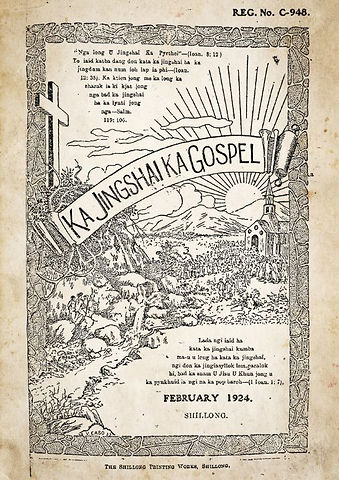
Ka Jingshai Ka Gospel (The Light of the Gospel) is a monthly publication from Shillong, first issued in June 1905. It serves as the official newspaper of the Church of God, with Rev. JJM Nichols Roy as one of its founding leaders and its first editor. Registered under the number C-948, this publication has proven to be remarkably resilient, as it continues to be in circulation to this day. The newspaper primarily carries Christian teachings and doctrines as upheld by the Church of God. Following the passing of Rev. Nichols Roy, editorial leadership passed on to Rev. Wolley Mohon Roy Roy, Rev. Healingson, and Rev. M.W. Laloo, who have continued to uphold its mission and legacy.
U Nongialap

U Nongialap (The Preacher) was a monthly newspaper published from Laitkynsew, first appearing in January 1922 without a registration number. A new series of the paper began in 1930, this time with the registration number C-2816. The first editor was M.K. Roy, who was later succeeded by T. Rodborne, the editor responsible for launching the new series. While the newspaper primarily conveyed the teachings and doctrines of the Welsh Calvinistic Methodist Church, it also included a significant amount of news from around the world. Additionally, it provided space for letters to the editor, encouraging reader engagement and dialogue.
U Woh

U Woh (The Critic) was a monthly secular newspaper published in Jowai, in the Jaiñtia Hills, with its first issue released in July 1928. The early editions had no registration number and were edited by Dr. B.T. Pugh. True to its secular character, the newspaper featured a wide array of content, with particular emphasis on the Letters to the Editor section, which the editor actively promoted. The paper published thought-provoking articles such as "Kaei ka Jingiapher Hapdeng u Pnar bad u Synteng?" ("What is the Difference Between Pnar and Synteng?") in the September 1928 issue and "Ka Indian National Congress" in January 1929.
In addition to socio-political commentary, U Woh included sections on general knowledge and health advice, broadening its appeal to a wider readership. Among its contributors were D.N.S. Wahlang, B. Pyrbot, and Nelson S. Mynso, who enriched the publication with their diverse perspectives and writings.
Ka Juk

Ka Juk (The Era) was a monthly newspaper published from Mawkhar, Shillong, with its first issue released in May 1933. Edited by A.S. Khongphai, it was registered under the number C-2086. The paper’s mission statement—"Ban tip ialade, shaniah ha lade, leh hi dalade, synshar ialade na ka bynta ka jingshai, jingbha bad jingroi ka ri"—translates to "To know oneself, trust oneself, do yourself, govern yourself for the purpose of knowledge, growth, and development of the land." Strongly secular in nature, Ka Juk featured writings on national affairs and pressing social issues such as marriage and divorce.
The newspaper also included a news capsule section, offering brief news snippets from around the world. Notable contributors included Hormurai Diengdoh, Jeebon Roy Mairom, and Mrs. D. Franklin, among others. The editor’s note in the inaugural issue stated that Ka Juk was a continuation of an earlier newspaper, U Ieit Ri, which had first appeared in January 1933 and was edited by O.S. Khongtir.
U Nongialam Khristan

U Nongialam Khristan (The Christian Leader) was a monthly newspaper published in Shillong, first issued in July 1902. It was owned by the Presbyterian Church and did not have a registration number. The publication was edited by Reverend J. Roberts and Reverend J.C. Evans. True to its name, the newsletter primarily focused on the teachings and doctrines of the Welsh Calvinistic Methodist Church, with limited coverage of socio-cultural news and events.
Some of the notable writings featured in the newspaper included Ka Skul Pynpaw (July 1902) and Ki Khubor Skul (August 1902). The publication did not include any bylines, reflecting its institutional rather than individual voice.
U Nongialam Katholik
.jpg)
U Nongialam Katholik (The Catholic Leader) was a monthly newspaper published in Laitkynsew, with its circulation beginning in January 1902. Edited by Father G. Abele, the publication did not have a registration number. In 1906, the newspaper was renamed Ïing Khristan (The Christian Home). As suggested by its name, the newspaper primarily focused on the news and teachings of the Catholic religion. However, it also included writings that contributed significantly to the growth and evolution of Khasi literature and culture.
Some of the notable writings published in U Nongialam Katholik included Ki Khasi Hyndai (November 1902) and Ki Kot Khubor Khasi (June 1903). Sib Charan Roy also contributed his writings to this publication, enriching its content and expanding its influence on the Khasi community.
U Nongpyrta

U Nongpyrta (A Clarion Call) was a monthly newspaper published from Laban, Shillong, with its first issue released in May 1921. It was registered under the number C-983. A notable aspect of this publication is that its editor, Monmatho Nath Das Gupta, was a non-Khasi. The newspaper developed a unique identity by focusing on spiritualism without aligning itself with any specific religion. It covered local news related to festivals, politics, and socio-cultural events, and also included anecdotes and moral quotes.
Prominent intellectuals who contributed to U Nongpyrta included Radhon Singh Berry Kharwanlang, Sib Charan Roy Dkhar, and U Soso Tham, who enriched the publication with their writings and perspectives.
Ka Jingshisha

Ka Jingshisha (The Truth) was a monthly newsletter published in Jowai by the Khasi Church, which is now known as the Church of North India in the Jaiñtia Hills. The newsletter first appeared in April 1925, registered under the number C-1004. It was edited by Reverend Lowell Gatphoh, with D. Sympotsing serving as the joint editor. While the newsletter primarily focused on the literature of the church, it also featured notable writings on the history of the Syiem Synteng and Syiem Sutnga, which were published in the November 1925 issue. Ka Jingshisha ceased circulation in 1928.
U Nongpynim

U Nongpynim (Life Giver) was a monthly newspaper published in Mawkhar, Shillong, with its first issue released in March 1928. The editor was Sib Charan Roy Dkhar. The earlier editions of the paper did not have a registration number, but an editor's note explained that the paper had not yet been assigned one by the government. However, the government had permitted the editor to begin circulation. This note was accompanied by an official letter signed by S.N. Mackenzie, the then Deputy Commissioner of the Khasi and Jaiñtia Hills. It is important to note that U Nongpynim replaced the editor’s earlier newspaper, U Nongphira, which had been banned by the government.
The third issue of U Nongpynim, published in May 1928, contained 28 pages. The newspaper became a strong advocate for the Khasi traditional religion, serving as a mouthpiece for the teachings and values of the Khasi faith. However, it faced oppressive measures from the British authorities, leading to a temporary closure between July and December 1930. The publication was allowed to resume in January 1931.
Ka Rympei

Ka Rympei (The Home) was a monthly magazine published in Shillong by the Synjuk Kynthei, a women's organization established in 1947. The magazine was first released in October 1969, and its editor was Mrs. Minette S. Tham. The first issue of the magazine featured its mission statement, which reads: “Ka Jingthmu bad ka jingangnud ha kaba pynmih ia kane ka kot khubor ka long ban ialam lynti, pynshai jingmut, ai jingkyntu bad pynmyntoi ia ngi ki kynthei ha ka rukom shong rukom sah, ia ka duk bad ka pyrkhat pyrdain ha kane ka juk mynta” (The purpose of this magazine is to lead the way in shaping the thoughts and minds of women towards progress and growth according to the times).
The magazine featured various sections, including thought-provoking articles, recipes, self-composed poems, health care tips, and guidance on raising a family. Prominent women thinkers from the state, such as Padmashree Kong Silverine Swer, Kong Khasimon Phanbuh, Dr. M. Dun, Kong Sitimon Sawian, and Kong D. Franklin, contributed to the magazine.
Notably, the magazine contained no photographs and had very minimal advertisements. It championed the cause of women and holds the distinction of being the first women's magazine in the state. Additionally, it was bilingual.
Ka Pansara

Ka Pansara (The Weighing Scale) was a monthly magazine published in Jowai with a registration number of NE-791. It made its debut in August 1978, and its editor was Bah Justman Kharmih. In the editorial of the first issue, the editor outlined the purpose of the magazine: to present the truth, carefully considered, so that readers could form informed opinions on the social and political matters affecting both themselves and the state.
The magazine featured balanced, well-thought-out analytical writings that covered a wide range of topics, from political commentary on the Janata Party to discussions on science and health, such as the concept of the ‘Test-tube Baby’. It also provided in-depth studies of both national and local events that were pertinent to the economic and social well-being of Khasi society.
Ka Pansara holds the distinction of being the first magazine to be published from the Jaiñtia Hills. Notably, it included no photographs or advertisements. The magazine ceased publication in 1994 when Mr. Justman Kharmih could no longer continue due to ill health.