top of page


In The Land of Clouds
Exploring Meghalaya's Cartographic Heritage
Cartography is the discipline concerned with the creation, distribution, and study of maps. A world without maps is one where navigating unfamiliar terrain would be daunting, and understanding the spatial relationships between places would be nearly impossible. Thanks to cartography, this is not a reality human civilization has to face.
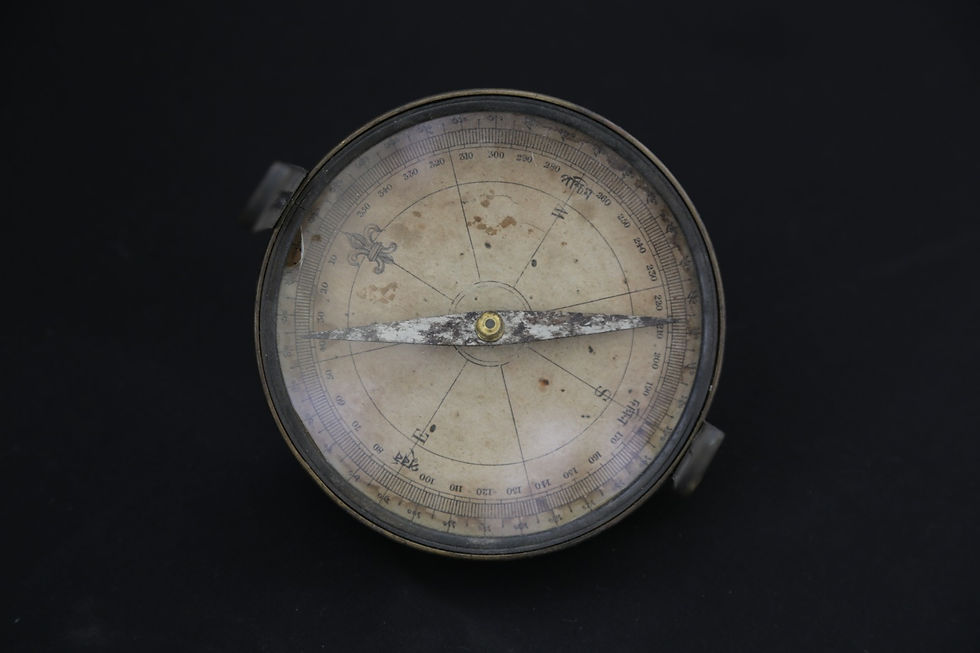
It has evolved from simple marks on the ground to hand-drawn maps which slowly evolved with the introduction of more sophisticated tools and methods to accurately project scale, location and distance between places. Tools like telescopes, compasses, and sextants allowed for increased accuracy. The invention and introduction of aerial photography and satellite imagery make mapping easier, however, it is important to remember the amount of innovation and drive it took to make maps ever since the idea of maps was conceived.
This exhibit seeks to highlight the history of Cartography and the contributions it brought to the Northeast region, especially Meghalaya. The collections showcased in this exhibit are mainly centered around Meghalaya’s cartographic history, beginning from the 19th century as well as the history of Cartography around the world.
Upon entering the Cartography Exhibit, one may notice the ceiling painted over to look like the night sky. This was meant to mimic the stars used by ships to navigate through the vast oceans, to make sure their course was right. Additionally the sky happens to also be the exact sky over Shillong on the night of it's statehood.


The Cartography Exhibit at the Museum possesses several artefacts and maps that are placed in rotation. Most of the maps were created in pre-Independent India and depict portions of Meghalaya before it even became a state. A few other maps also made post-independence depict various Himas/ Chiefdoms, Districts and physical geological formations.



bottom of page